Will AI Take Your Job? What the Evidence Says About Work and Automation
AI is changing work task by task rather than job by job. A balanced look at which roles are most exposed, what history suggests and how to stay valuable as tools improve.
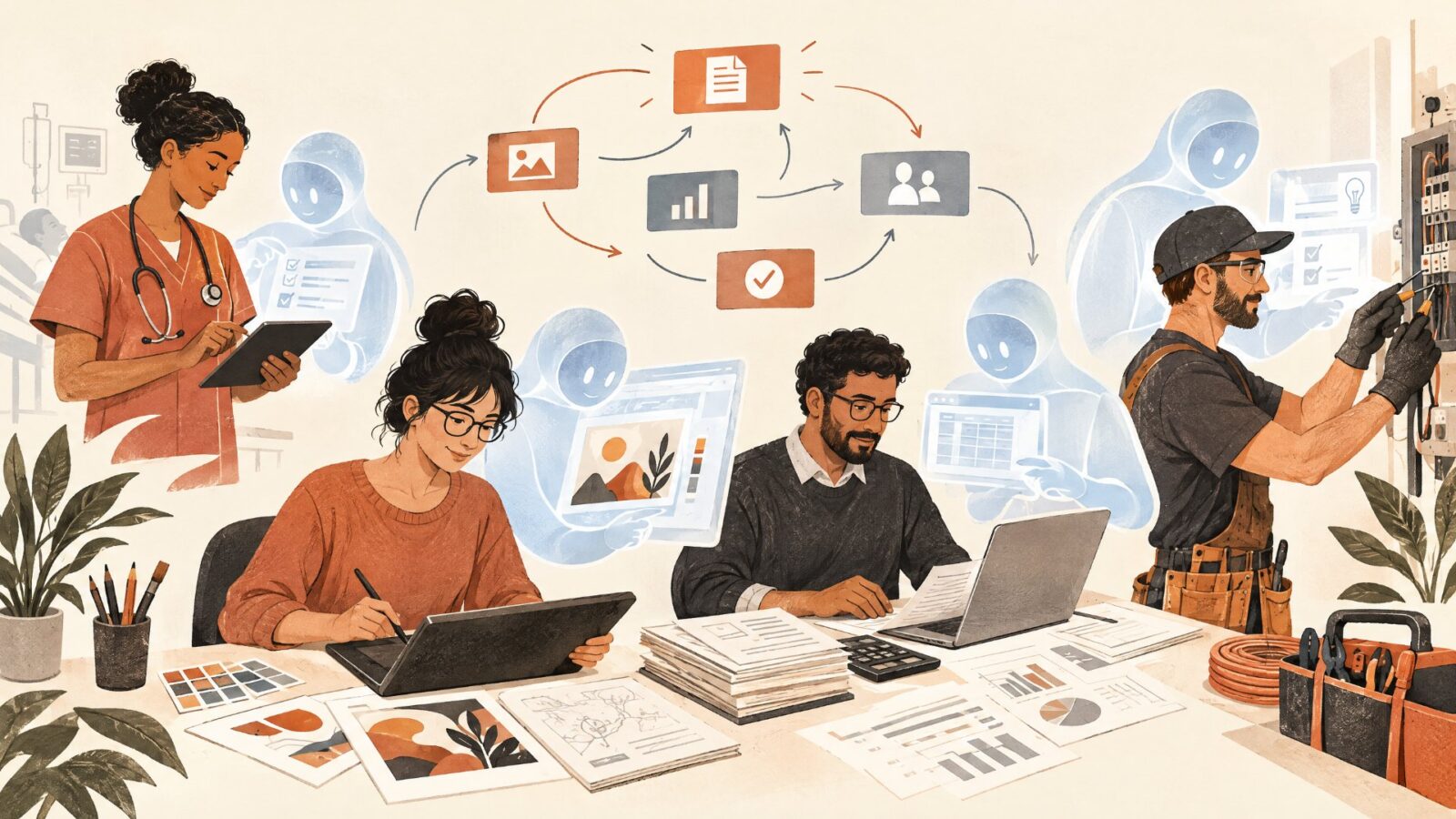
- AI mostly automates tasks within jobs; whole occupations rarely disappear overnight.
- Knowledge work involving routine writing, analysis and coding is more exposed than in earlier automation waves.
- Workers who learn to use AI well, and who strengthen judgment and relationship skills, are best positioned.
Few questions about artificial intelligence generate as much anxiety as this one. Headlines swing between predictions of mass unemployment and assurances that nothing much will change. The honest answer is more nuanced, and more useful, than either extreme.
Think in tasks, not jobs
Almost every job is a bundle of tasks. A marketing coordinator writes copy, schedules posts, analyzes results, talks to colleagues and makes judgment calls about the brand. AI can already speed up some of those tasks dramatically. Others—understanding what a particular client really wants, negotiating with a vendor, deciding which idea fits the company’s direction—remain firmly human.
Economists who study automation consistently find that technology changes the mix of tasks within jobs more often than it eliminates jobs entirely. When a job is mostly made of tasks AI does well, that job is genuinely at risk of shrinking. When AI handles only part of a job, the role tends to evolve, and productivity rises.
What is different this time
Earlier waves of automation mainly affected physical and routine work: factory assembly, bookkeeping, typing pools. Generative AI is unusual because it reaches into cognitive work—writing, summarizing, translating, coding, analyzing data and designing. Studies from international organizations and research institutions have found that a large share of jobs in advanced economies include tasks exposed to generative AI, with exposure especially high in clerical and professional roles.
“Exposed,” however, does not mean “replaced.” Exposure means AI could affect how the work is done. Whether that leads to job losses, new kinds of jobs or simply more productive workers depends on how businesses choose to use the technology, on demand for the work, and on policy.
Roles under more pressure
- Routine content production, such as basic product descriptions or template-based articles.
- Entry-level data processing and administrative support involving forms, scheduling and data entry.
- First-line customer support handling repetitive questions.
- Basic translation and transcription where perfect nuance is not essential.
Roles likely to be reshaped rather than replaced
- Software developers, who increasingly direct AI tools and review their output.
- Lawyers, accountants and analysts, whose research and drafting speed up while accountability remains human.
- Teachers and trainers, who can personalize materials faster but whose core value is human connection and judgment.
- Marketers and designers, who produce more variations faster and focus on strategy and taste.
Roles least affected in the near term
Jobs that combine physical dexterity in unpredictable environments, deep interpersonal trust or hands-on care—electricians, nurses, plumbers, social workers, chefs—are less directly affected by generative AI, though software may still change their paperwork and scheduling.
What history suggests
Technological change has repeatedly destroyed some jobs while creating others that were hard to imagine beforehand. Spreadsheets did not eliminate accountants; they changed what accountants spend time on, and demand for financial analysis grew. ATMs did not end bank teller jobs immediately; banks opened more branches and tellers shifted toward customer service. These transitions were real and painful for many individuals, but the overall amount of work did not vanish.
The most realistic near-term risk is not that AI takes your job. It is that someone who uses AI well does your job better and faster than someone who does not.
History does not guarantee the future, and the speed of AI progress is a genuine reason for caution. Transitions can be uneven, hitting particular regions, age groups or professions hard even when the overall economy adjusts.
How to stay valuable
- Get hands-on with AI tools in your field. Learn what they do well, where they fail and how to direct them effectively.
- Move up the value chain. Focus on problem definition, judgment, quality control and decisions—tasks AI supports but does not own.
- Strengthen human skills. Communication, negotiation, leadership, empathy and building trust are hard to automate.
- Build domain expertise. Knowing a field deeply lets you spot when AI output is subtly wrong, which is increasingly valuable.
- Keep learning in small steps. Regular short practice beats occasional crash courses.
What employers and policymakers can do
Companies that redeploy and retrain staff, rather than treating AI purely as a cost-cutting tool, tend to keep valuable institutional knowledge. Governments are debating measures ranging from retraining programs and updated education to stronger social safety nets. The choices made by businesses and policymakers will shape whether AI’s productivity gains are broadly shared.
The bottom line
AI will change most jobs, eliminate some tasks and create new ones. For individuals, the most effective response is neither panic nor denial but practical engagement: learn the tools, focus on the parts of your work that need human judgment, and keep building skills. Those steps are within your control regardless of how fast the technology moves.
Frequently asked questions
Which skills are most future-proof?
Critical thinking, communication, domain expertise, adaptability and the ability to work effectively with AI tools are consistently valuable across fields.
Should I change careers because of AI?
Not on headlines alone. Look at which tasks in your role are most automatable and whether your field is growing. Often the better move is to adapt within your profession.
Will AI create new jobs?
It already has, in areas such as AI operations, data work, evaluation and governance, and in roles that combine domain expertise with AI skills.

Mark Halden is the editor of PB Tech Journal. He writes plain-English explainers and practical guides on artificial intelligence, with a focus on how everyday users and small businesses can use AI tools effectively, safely and responsibly.