How to Spot AI-Generated Images, Video and Text
Synthetic media is getting harder to spot by eye. These practical checks for images, video, audio and writing, plus the tools and habits that matter more than any single clue.
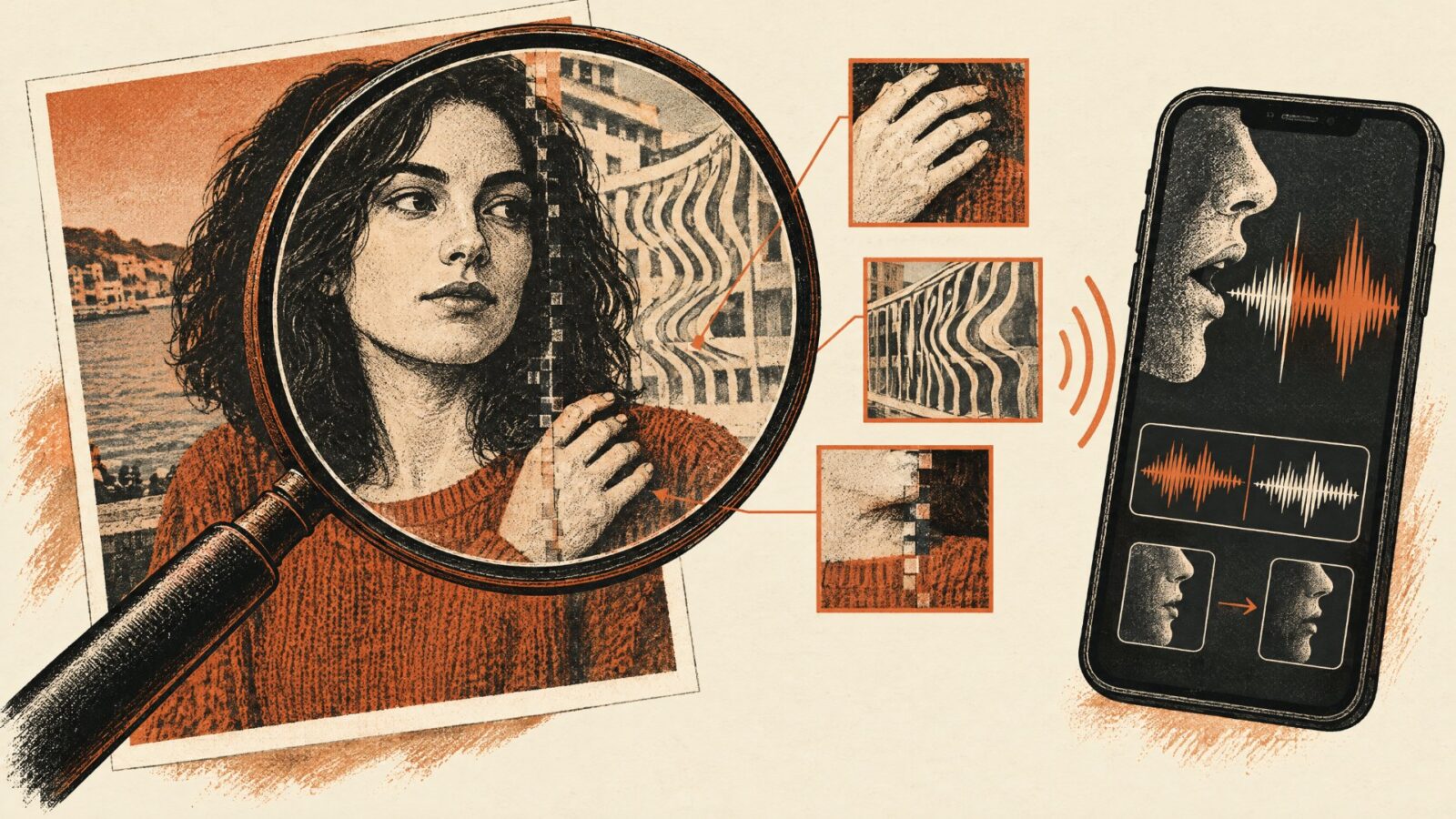
- Visual glitches still appear, but the best AI media can look flawless—do not rely on artifacts alone.
- Context checks (source, date, reverse search, corroboration) are more reliable than pixel hunting.
- AI text detectors are unreliable and should never be the sole basis for accusing someone.
A photo of a public figure in an unlikely situation. A video of a politician saying something outrageous. A phone call that sounds exactly like a relative asking for money. Generative AI has made synthetic media cheap and convincing, and that changes how carefully we need to look at what we see and hear online. The good news is that a handful of habits catch most fakes, even as the technology improves.
Start with context, not pixels
Before zooming in on fingers and shadows, ask the questions journalists ask:
- Who posted it first? Trace it back to the original source. An anonymous account with no history is a warning sign.
- Is it reported elsewhere? Significant real events are usually covered by several credible outlets.
- Does it play on strong emotions? Content designed to make you angry or frightened spreads fastest and deserves the most scrutiny.
- Does the timing make sense? Check whether the people, places and weather match the claimed date.
- Can you find earlier versions? A reverse image search may reveal the original photo or show it was generated.
These checks work regardless of how good the AI becomes, which is why they matter more than any visual tell.
Clues in AI-generated images
Image models have improved dramatically, but they still sometimes leave traces:
- Hands and teeth with odd counts, merged fingers or unnatural shapes.
- Text in the scene—signs, labels, license plates—that is garbled or nonsensical.
- Inconsistent lighting and shadows, with light coming from different directions.
- Accessories that do not match, such as mismatched earrings or glasses that melt into skin.
- Backgrounds that blur into abstraction, with repeated patterns or distorted people in crowds.
- An overly polished, airbrushed look where skin and surfaces seem too perfect.
The absence of these clues does not prove an image is real. Treat them as reasons for suspicion, not as a final test.
Clues in deepfake video and audio
| Look or listen for | What it can indicate |
|---|---|
| Lips slightly out of sync with speech | Face or voice was swapped or generated |
| Unnatural blinking or a fixed gaze | Synthetic facial animation |
| Flickering around the edges of the face or hair | Face replacement blending errors |
| Flat emotion or odd pacing in the voice | Voice cloning |
| Missing breaths or background noise that cuts in and out | Audio stitched or generated |
Voice-cloning scams
A few seconds of someone’s voice from social media can be enough to create a convincing clone. Scammers use this to impersonate family members in distress or executives requesting urgent payments. Protect yourself with a simple rule: verify through a separate channel. Hang up and call the person back on a number you already have. Some families agree on a private code word for emergencies.
Urgency is the scammer’s best tool. Any request that combines a familiar voice, a crisis and a demand for money right now deserves a pause and a call-back.
Spotting AI-written text
AI-generated writing often has recognizable tendencies: smooth but generic phrasing, balanced lists of points, few concrete personal details, confident claims without sources and, sometimes, fabricated facts or citations. But many careful human writers share some of these traits, and AI can be prompted to write in a more personal style.
Automated AI text detectors are unreliable. They produce false positives, and studies have found they are more likely to flag writing by non-native English speakers. They should never be the only evidence used to accuse a student, employee or writer. A better approach is to discuss the work with the person, ask about their process, and look at drafts and sources.
Tools that help
- Reverse image search tools from major search engines can locate earlier copies of an image.
- Content credentials: an industry standard known as C2PA lets cameras, editing software and some AI tools attach tamper-evident information about how a file was created. Some platforms display this information.
- Invisible watermarks: several AI companies embed hidden markers in generated images or audio that dedicated tools can detect.
- Fact-checking organizations often investigate viral images and videos quickly.
None of these is complete. Watermarks can be stripped, and credentials only help if they were attached in the first place. Use them as part of a broader check.
Teach the habit, not just the tricks
The most durable defense is a mindset: slow down, check the source, look for corroboration and be especially skeptical of content that confirms what you already wanted to believe. Sharing these habits with family members—particularly older relatives and teenagers, who are frequent targets—does more good than any single detection tool.
The bottom line
As generative AI improves, spotting fakes by eye will become harder. Context-based verification, separate-channel confirmation and healthy skepticism will remain effective. Treat visual clues as hints, treat detection tools as helpers, and treat your own judgment as the final filter.
Frequently asked questions
Can I trust an AI detector’s percentage score?
No. Scores are estimates with significant error rates. Use them, at most, as a prompt for further investigation.
Is all AI-generated media harmful?
Not at all. AI images and voices are widely used for art, accessibility and entertainment. The problem is deception, not the technology itself.
What should I do if I find a deepfake of myself?
Document it with screenshots and links, report it to the platform, and seek legal advice if it is defamatory or explicit. Many platforms have specific reporting routes for synthetic media.

Mark Halden is the editor of PB Tech Journal. He writes plain-English explainers and practical guides on artificial intelligence, with a focus on how everyday users and small businesses can use AI tools effectively, safely and responsibly.