AI Hallucinations: Why Chatbots Make Things Up and How to Catch Them
Fake citations, invented statistics and confident nonsense are a built-in risk of language models. Learn why they happen and a simple routine for catching them before they cause harm.
- A hallucination is fluent, confident output that is false or unsupported.
- It happens because models predict plausible text rather than consult a store of verified facts.
- Grounding the model in sources, asking for uncertainty and verifying specifics dramatically lowers the risk.
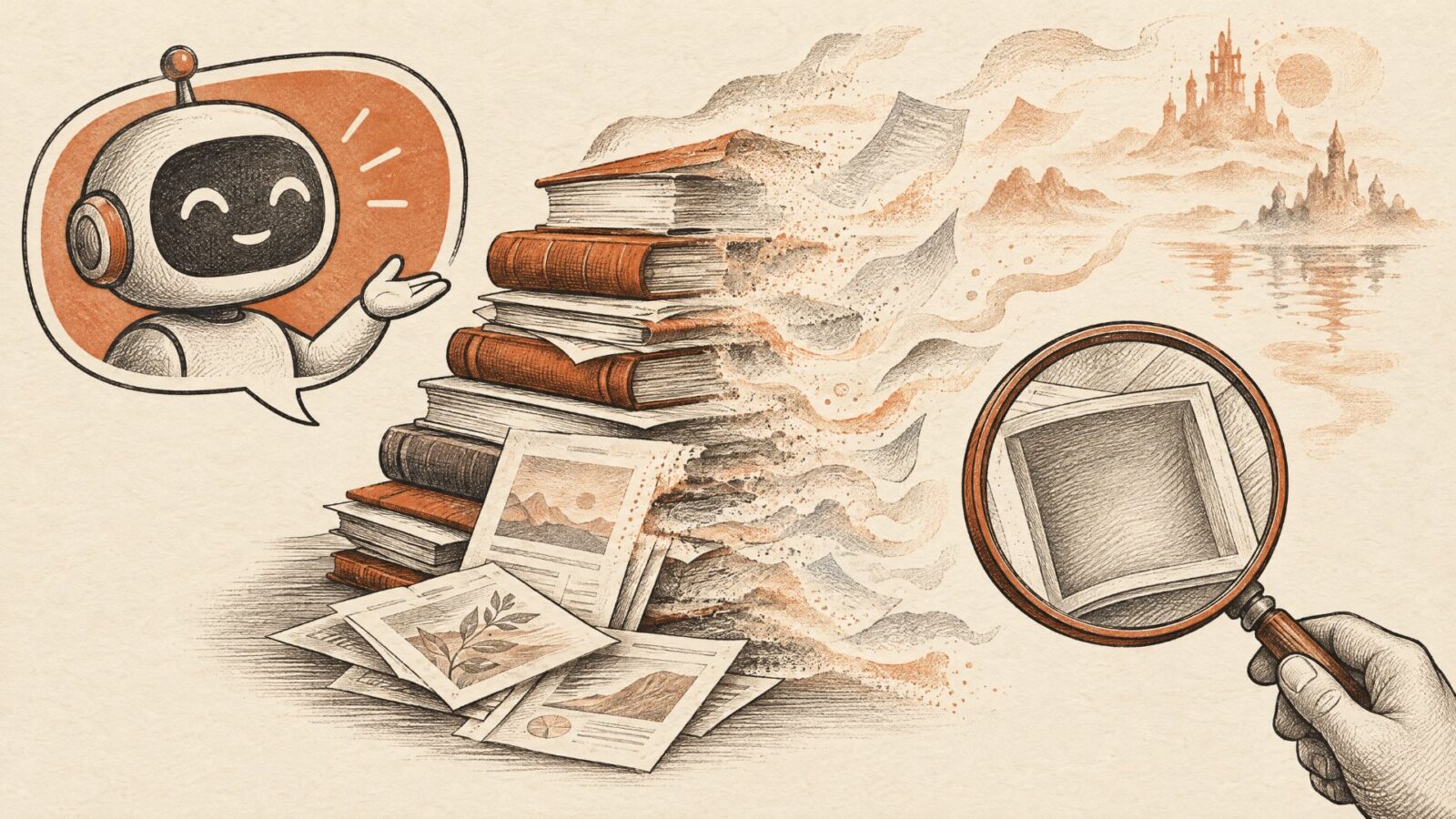
Ask an AI chatbot for five academic papers on a niche topic and you may get five perfectly formatted citations—authors, journal, year, page numbers. Search for them and some may not exist. The model did not lie in any intentional sense. It produced what a citation on that topic would plausibly look like. This phenomenon is called hallucination, and it is one of the most important things to understand before relying on generative AI for anything that matters.
What counts as a hallucination
The term covers any output that sounds authoritative but is not grounded in reality or in the material you provided. Common forms include:
- Fabricated sources: books, articles, court cases or URLs that do not exist.
- Invented numbers: precise-sounding statistics with no real basis.
- Wrong attributions: real quotes assigned to the wrong person, or quotes that were never said.
- Distorted summaries: a summary of your document that adds claims the document never made.
- Confident reasoning errors: a step-by-step explanation that contains a subtle mistake and reaches the wrong conclusion.
Why it happens
As we explain in our guide to how language models work, these systems generate text by predicting the most likely next token. They are rewarded during training for producing text that looks right. Most of the time, looking right and being right overlap. When the model lacks reliable information—because the topic is obscure, recent or highly specific—it still produces something that looks right. There is no built-in alarm that rings when it reaches the edge of its knowledge.
Several factors make hallucinations more likely:
- Rare or niche topics with little training data.
- Requests for exact details such as dates, figures, names and citations.
- Leading questions that assume a false premise (“Why did the company recall its product in 2019?” when no recall happened).
- Long, complex tasks where small errors compound.
- Pressure to answer, including prompts that discourage the model from saying it does not know.
Real-world consequences
Hallucinations stop being a curiosity when they leave the chat window. There have been widely reported cases of lawyers submitting court filings that cited non-existent cases generated by a chatbot, leading to sanctions from judges. Businesses have published AI-written articles containing factual errors that damaged their credibility. In health, finance and law, an unverified answer can lead to real harm.
The danger is not that AI is sometimes wrong. People are sometimes wrong too. The danger is that AI is wrong in exactly the same confident tone it uses when it is right.
How to reduce hallucinations when you prompt
Give it the facts first
The single most effective technique is grounding: provide the source material and tell the model to use only that. “Using only the report below, list the three main recommendations” is far safer than “What does the report recommend?”
Invite uncertainty
Explicitly allow the model to say it does not know. Add a line such as: “If you are not sure, say so rather than guessing.” This simple instruction often reduces fabricated detail.
Ask for sources you can check
When a tool has web access, ask it to link the specific pages supporting each claim. Then open them. A citation you have not clicked is not a citation.
Break big tasks into smaller steps
Ask for an outline first, check it, then ask for each section. Errors are easier to spot in short pieces than buried in a long essay.
Lower the creativity
If your tool offers a temperature or “creativity” setting, keep it low for factual work.
A five-minute verification routine
| Check | What to do |
|---|---|
| Names and titles | Search each person, book, paper or organization mentioned. |
| Numbers | Find the original source of every statistic; if you cannot, remove it. |
| Quotes | Search the exact phrase in quotation marks. |
| Links | Open every URL and confirm it says what the AI claims. |
| Logic | Re-read conclusions and ask whether they actually follow from the evidence. |
Can hallucinations be eliminated?
Not entirely, at least with current approaches. Developers have made real progress by connecting models to search engines and document databases, training them to express uncertainty, and having them check their own work. Hallucination rates on many tasks have fallen as models improve. But because the underlying mechanism is probabilistic prediction, some risk remains. The responsible approach is to design workflows that assume errors will occasionally occur and catch them before they matter.
The bottom line
Treat AI output the way an editor treats a draft from a talented but inexperienced writer: useful, often impressive, never published without checking. The more specific and consequential a claim is, the more important it becomes to verify it yourself.
Frequently asked questions
Are some AI tools less prone to hallucinations?
Tools that search the web or work from documents you supply generally hallucinate less on factual questions, though they can still misread sources. Always check the linked material.
Why does the AI apologize and then make another mistake?
Correcting a model gives it new context, but it is still predicting text. It may produce a different plausible answer that is also wrong. Provide the correct information directly when you can.
Is a hallucination the same as bias?
No. Bias refers to systematic skew in outputs, often inherited from training data. Hallucination refers to fabricated or unsupported content. Both can occur together.

Mark Halden is the editor of PB Tech Journal. He writes plain-English explainers and practical guides on artificial intelligence, with a focus on how everyday users and small businesses can use AI tools effectively, safely and responsibly.