What Is Generative AI? A Plain-English Guide for Curious Beginners
Generative AI writes, draws and talks, but it does not think the way people do. Here is what the technology actually is, how it learned to create, and where its limits are.

- Generative AI produces new content—text, images, audio, code—by learning statistical patterns from very large datasets.
- It predicts plausible output; it does not retrieve verified facts or understand the world the way humans do.
- It is most useful as a fast first-draft partner, and least reliable when accuracy matters and nobody checks the result.
A few years ago, “artificial intelligence” mostly meant software that sorted things: spam or not spam, fraud or not fraud, cat photo or dog photo. Today the term is just as likely to describe software that makes things. Ask a chatbot for a cover letter and it writes one. Describe a sunset over a city that does not exist and an image model paints it. This newer branch of the field is called generative AI, and it has moved from research labs to everyday phones in a remarkably short time.
This guide explains what generative AI is, how it works at a level that does not require a math degree, what it is genuinely good at, and where it routinely goes wrong.
The short definition
Generative AI is a category of machine-learning systems designed to create new content that resembles the data they were trained on. A text model trained on billions of sentences learns to produce new sentences. An image model trained on huge collections of captioned pictures learns to produce new pictures that match a description. The output is new in the sense that it was not copied from a single source, but it is built entirely from patterns the model absorbed during training.
That last point matters. A generative model is not a search engine and not a database. When it answers a question, it is not looking up a stored fact. It is producing the sequence of words that, based on its training, is most likely to follow your request.
How a machine learns to create
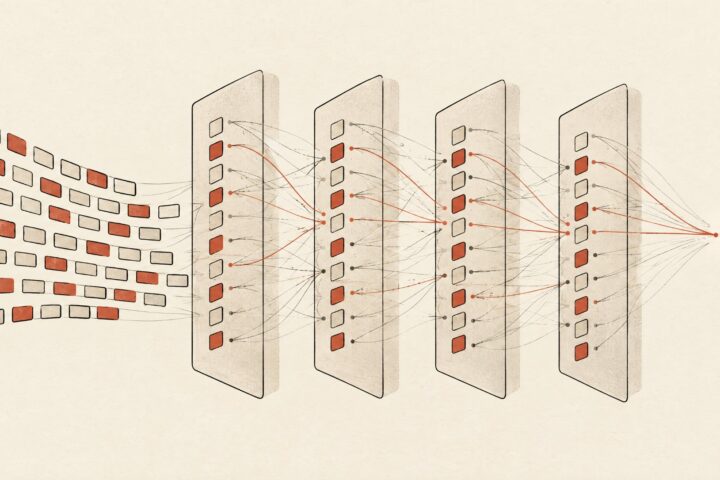
Most of today’s generative systems are built on neural networks: layered mathematical structures loosely inspired by how neurons connect in the brain. A network starts with millions or billions of adjustable numbers called parameters. During training, it is shown an enormous number of examples and asked to make predictions. Each time it is wrong, the parameters are nudged slightly so that the next prediction is a little better.
For a text model, the training task is deceptively simple: given some words, predict the next one. Repeat that across a meaningful slice of the public internet, books and other sources, and the model gradually picks up grammar, facts, writing styles, reasoning patterns and even the structure of computer code. No one programs these abilities directly. They emerge because they help the model predict text more accurately.
Image generators often use a different technique called diffusion. During training, the model watches images being gradually buried in random noise, and learns to reverse that process step by step. Once trained, it can start from pure noise and “clean it up” into a brand-new image, guided by the words in your prompt.
The main types of generative AI
| Type | What it produces | Common uses |
|---|---|---|
| Large language models | Text and code | Drafting, summarizing, translating, answering questions, programming help |
| Image models | Pictures and illustrations | Concept art, marketing visuals, mockups, photo editing |
| Audio and voice models | Speech, music, sound effects | Narration, accessibility tools, podcast cleanup |
| Video models | Short video clips | Storyboards, ads, social content, visual effects |
| Multimodal models | A mix of the above | Describing photos, reading charts, combining text and images |
What generative AI is genuinely good at
The technology shines when the cost of a mediocre first attempt is low and a human can quickly judge the result. Typical strengths include:
- Getting past the blank page. Outlines, first drafts, alternative headlines and brainstorm lists arrive in seconds.
- Reshaping existing material. Summarizing a long report, turning notes into an email, or rewriting a paragraph for a different audience.
- Translation and tone. Converting text between languages or between formal and casual registers.
- Explaining concepts. Breaking down a topic at whatever level you ask for, then answering follow-up questions patiently.
- Routine code. Writing small scripts, explaining error messages and suggesting fixes that a developer then tests.
Where it reliably struggles
Because generative models optimize for plausibility rather than truth, they can produce confident answers that are simply wrong. Researchers call this hallucination. A model might invent a statistic, a book title or a legal case that sounds real. It may also struggle with precise arithmetic, very recent events it was never trained on, and tasks that require knowing your specific situation.
There are subtler limits too. Models can reflect biases present in their training data. They do not have personal experience or common sense in the human sense. And their quality depends heavily on how clearly the request is framed, which is why good prompting has become a practical skill.
A useful mental model: treat generative AI like a very well-read assistant who has never left the library and occasionally makes things up to be helpful.
Is it “intelligent”?
This question sparks endless debate. Generative models can solve problems, follow complex instructions and write convincingly about almost anything, which looks a lot like intelligence. At the same time, they lack persistent goals, lived experience and a reliable sense of what they do not know. A practical answer is that these systems are powerful pattern engines with impressive, uneven abilities. Judging them by results—where do they help, where do they fail—is more productive than arguing about labels.
How to start using it sensibly
- Begin with low-stakes tasks. Drafting a newsletter or summarizing meeting notes is a better first test than medical or legal questions.
- Give context. Tell the tool who the audience is, what the goal is and what format you want.
- Verify anything factual. Check names, numbers, quotes and sources against reliable references.
- Protect sensitive data. Read our guide to AI and privacy before pasting personal or confidential information.
- Keep your judgment in the loop. The best results come from people who edit, question and improve what the model produces.
The bottom line
Generative AI is neither magic nor a fad. It is a genuinely new kind of tool that can save time on a wide range of writing, design and analysis tasks, provided its output is treated as a draft rather than a verdict. Understanding how it works—prediction, not knowledge—is the single most useful thing a new user can learn.
Frequently asked questions
Is generative AI the same as ChatGPT?
No. ChatGPT is one well-known product built on a large language model. Generative AI is the broader category, which includes many chatbots, image generators, voice tools and video systems from different companies.
Does generative AI copy its training data?
Usually it produces new combinations of learned patterns rather than copying, but it can occasionally reproduce memorized passages or styles closely. This is one reason copyright questions around AI remain unsettled.
Do I need technical skills to use it?
Not for everyday tasks. Clear writing and a habit of checking results matter far more than programming knowledge.

Mark Halden is the editor of PB Tech Journal. He writes plain-English explainers and practical guides on artificial intelligence, with a focus on how everyday users and small businesses can use AI tools effectively, safely and responsibly.