How Large Language Models Actually Work, Explained Without the Jargon
Tokens, transformers, training and fine-tuning: a clear walk-through of what happens inside the chatbots millions of people now use every day.
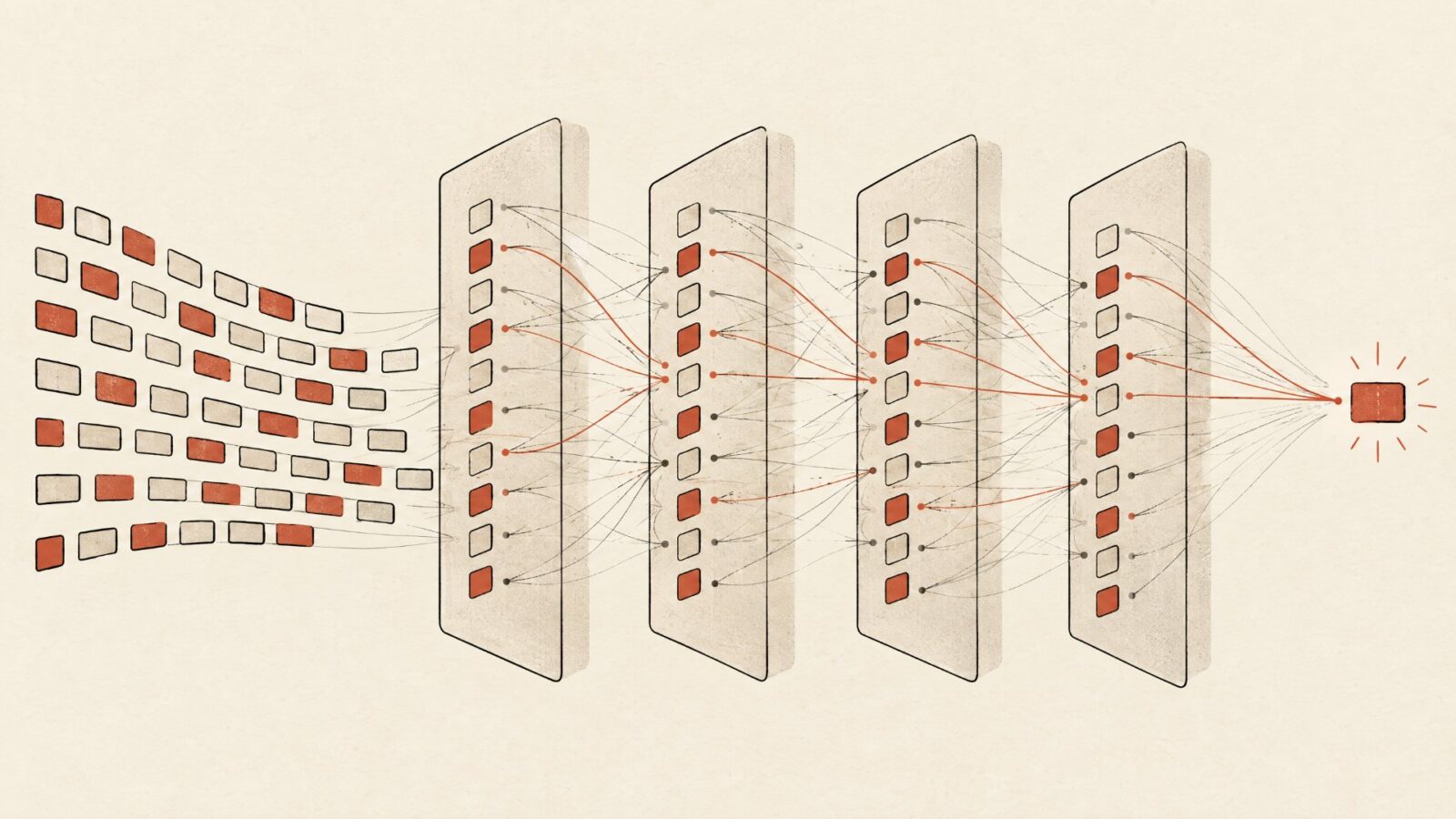
- Language models break text into small pieces called tokens and repeatedly predict the next one.
- The transformer architecture lets a model weigh how every word in a passage relates to every other word.
- Chatbots are built in stages: broad pre-training, then fine-tuning and feedback to make them helpful and safer.
When you type a question into an AI chatbot and watch the answer appear word by word, it is natural to imagine something like a person thinking. What is actually happening is stranger and, in some ways, more interesting. A large language model, or LLM, is a prediction machine operating at enormous scale. Understanding its basic mechanics makes it much easier to use well and to spot when it is likely to fail.
Step one: turning words into tokens
Computers do not read letters the way people do. Before a model can process text, the text is split into tokens. A token can be a whole common word (“house”), part of a longer word (“un”, “believ”, “able”), a punctuation mark or a space. As a rough rule of thumb in English, one token is about three-quarters of a word.
Each token is then converted into a long list of numbers called an embedding. You can think of an embedding as coordinates on a vast map of meaning. Words used in similar contexts—”doctor” and “physician,” for example—end up close together on that map. This numerical form is what the model actually manipulates.
Step two: the transformer pays attention
Most modern language models are based on an architecture called the transformer, introduced by Google researchers in 2017 in a paper titled “Attention Is All You Need.” Its key innovation is a mechanism called attention.
Consider the sentence: “The trophy didn’t fit in the suitcase because it was too big.” What does “it” refer to? Humans instantly know it is the trophy. Attention lets a model make similar connections by calculating, for every token, how strongly it should relate to every other token in the passage. The model does this many times over, in many layers, each layer refining its picture of what the text means.
Because attention compares tokens in parallel rather than reading strictly left to right, transformers can be trained efficiently on huge amounts of data using modern chips. That efficiency is a big part of why language models improved so quickly.
Step three: predicting the next token
After all those layers, the model produces a probability for every possible next token. If the text so far is “The capital of France is,” the token “Paris” will receive a very high probability. The system picks a token—usually one of the most likely, with a little controlled randomness—adds it to the text, and repeats the whole process for the next token.
That loop is the entire act of “writing.” A long, thoughtful-sounding answer is built one token at a time, each choice conditioned on everything that came before. The randomness setting, often called temperature, controls how adventurous the choices are. Low temperature produces predictable, focused text; high temperature produces more varied and creative, but also more error-prone, output.
How the model learned all this
Pre-training
In the first and most expensive phase, the model reads a vast collection of text and practices predicting missing or next tokens billions of times. Its internal parameters—often numbering in the billions—are adjusted after each mistake. Over time, the model encodes grammar, facts, styles, and patterns of reasoning, all as a side effect of getting better at prediction.
Fine-tuning
A freshly pre-trained model is knowledgeable but not especially helpful. It might continue your question with more questions rather than answering it. Developers therefore fine-tune it on curated examples of good conversations: clear questions paired with high-quality answers.
Learning from feedback
Many chatbots then go through a stage where human reviewers compare different responses and indicate which are better. The model is trained to prefer the kinds of answers people rated highly. This technique, often called reinforcement learning from human feedback, is a major reason assistants became more polite, more on-topic and more likely to decline harmful requests.
The context window: a model’s working memory
A model can only consider a limited amount of text at once, known as its context window. Everything in the current conversation—your messages, its replies, any documents you pasted—must fit inside it. Context windows have grown dramatically, but they are still finite. When a conversation gets very long, earlier details may be dropped or given less weight, which is why models sometimes “forget” instructions you gave at the start.
Why this design explains common failures
- Confident errors. The model is optimizing for likely text, not verified truth, so a fluent but false sentence can score highly. See our deep dive on AI hallucinations.
- Weak arithmetic. Numbers are split into tokens in awkward ways, and calculation is not what next-token prediction is built for. Many tools now hand math off to a calculator or code.
- Outdated knowledge. A model only knows what was in its training data up to a cutoff date unless it is connected to search or other live sources.
- Sensitivity to wording. Small changes in a prompt change the context the model conditions on, which can noticeably change the answer.
Tools, retrieval and the move toward agents
To overcome some of these limits, developers increasingly connect language models to external tools. With retrieval, the system first searches a set of documents and places the relevant passages into the context window, so the model answers from real sources. With tool use, the model can call a calculator, run code or query a database. Combine those abilities with the capacity to plan multiple steps and you get what are now called AI agents.
The bottom line
A large language model is a statistical system that has absorbed patterns from an immense amount of text and uses them to predict what comes next, one token at a time. That simple loop, scaled up and refined with human feedback, produces surprisingly capable assistants. Remembering that the engine underneath is prediction—not understanding or lookup—is the key to using these tools productively and safely.
Frequently asked questions
Do language models think?
They perform computations that can resemble reasoning, and they can work through multi-step problems. Whether that counts as thinking is a philosophical debate; practically, they lack persistent goals and reliable self-knowledge.
Why do bigger models tend to perform better?
More parameters, more data and more computing power generally let a model capture subtler patterns. Gains are not unlimited, though, and data quality and training methods matter as much as raw size.
Does a chatbot learn from my conversation?
Within a single chat, it uses your messages as context. Whether your conversations are later used to train future models depends on the provider’s policy and your settings.

Mark Halden is the editor of PB Tech Journal. He writes plain-English explainers and practical guides on artificial intelligence, with a focus on how everyday users and small businesses can use AI tools effectively, safely and responsibly.