AI Agents Explained: From Chatbots to Software That Takes Action
An AI agent does not just answer questions; it plans, uses tools and completes multi-step tasks. Here is how agents work, what they can do today and the risks of handing software the keys.
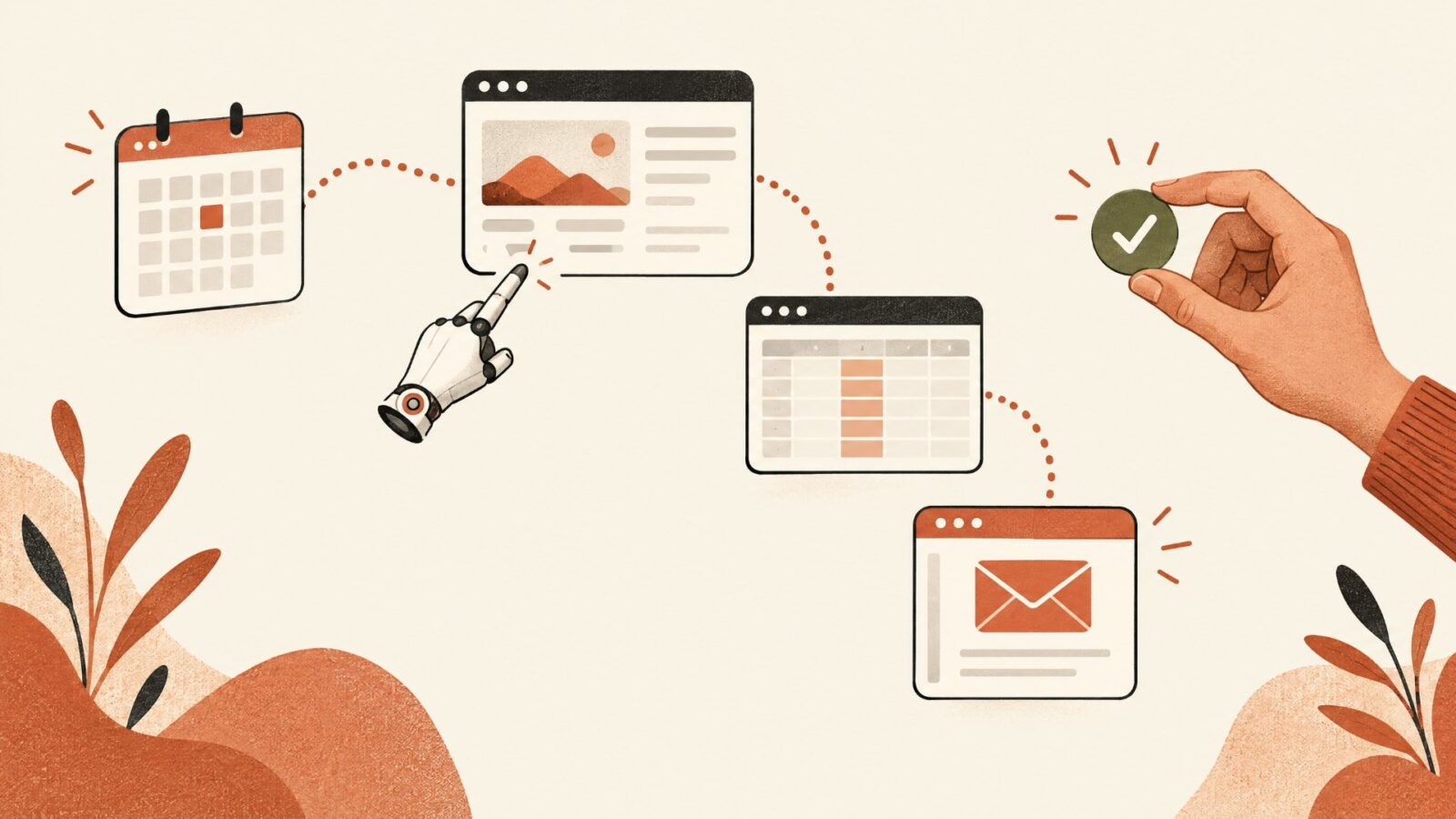
- An AI agent combines a language model with tools, memory and a loop that lets it plan and act.
- Agents can browse, write and run code, fill in forms and coordinate tasks across apps.
- Reliability, security and clear human approval points are the main challenges.
For most people, AI first arrived as a chat box: you ask, it answers. The next step is software that does not stop at answering. Ask it to research three suppliers, compare their prices and draft an email to the best one, and it goes and does the work. Systems like this are called AI agents, and they are one of the most active areas of development in the field.
What makes something an “agent”
There is no single official definition, but most agents share four ingredients:
- A reasoning engine, usually a large language model, that interprets the goal and decides what to do next.
- Tools it can call: a web browser, a search engine, a code interpreter, a calendar, email, a spreadsheet, or a company’s internal systems.
- Memory to keep track of what it has already done, what it learned and what remains.
- A loop: plan a step, take an action, observe the result, adjust, and repeat until the task is finished or it needs help.
A chatbot gives you information. An agent turns information into actions.
How an agent works through a task
Imagine asking an agent: “Find a quiet hotel near the conference center for next month’s trip and put the options in a table.”
- It breaks the goal into steps: identify the conference location and dates, search for nearby hotels, check reviews for noise complaints, compare prices.
- It uses a search tool, reads several pages and extracts relevant details.
- When a page fails to load, it tries another source.
- It compiles the findings into the requested table and reports back, noting anything it could not confirm.
Each step is a cycle of thinking, acting and checking. This loop is what allows agents to handle tasks that would take a chatbot many back-and-forth messages.
What agents can do today
| Area | Example tasks |
|---|---|
| Research | Gather sources on a topic, summarize findings and cite links |
| Software development | Read a codebase, fix a bug, run tests and propose changes |
| Office work | Turn a spreadsheet into a report, draft replies, schedule meetings |
| Customer support | Look up an order, process a simple return, escalate complex cases |
| Data analysis | Clean a dataset, run calculations and produce charts |
Coding has been one of the earliest areas where agents became genuinely useful, because results can be checked automatically: the code either passes its tests or it does not.
Why agents are hard to get right
Errors compound
If a model is right 95 percent of the time on each step, a twenty-step task has a much lower chance of finishing perfectly. Small mistakes early on can send an agent down the wrong path. Good agent design includes checkpoints and the ability to recover.
The real world is messy
Websites change layout, logins expire, pop-ups appear, and instructions are ambiguous. Humans handle this mess intuitively; agents often stumble.
Security risks are new
An agent that reads web pages or emails can encounter prompt injection: hidden text that tries to trick it into doing something its user never asked for, such as sending data elsewhere. Because agents can act, a successful manipulation can have real consequences. Responsible systems treat content they read as information, not as commands, and ask the user before sensitive actions.
Accountability
When an agent books the wrong flight or sends an inappropriate message, who is responsible? Businesses deploying agents need clear policies, logs of what the agent did and limits on what it is allowed to do.
The most useful agents today are not fully autonomous. They do the tedious legwork and pause for a human decision at the moments that matter.
Using agents safely
- Start with reversible tasks, like research and drafting, before letting an agent send, buy or delete anything.
- Require confirmation for payments, messages and changes to accounts.
- Grant the minimum access needed for the job.
- Review the log of actions, especially in the early weeks of using a new tool.
- Keep sensitive credentials out of reach and handle sign-ins yourself.
Where this is heading
Expect agents to become more common inside the software people already use—email clients, office suites, browsers and business platforms—rather than as standalone novelties. Multiple specialized agents may also work together, one researching, another writing, another checking quality. The trajectory is toward AI as a collaborator that handles whole tasks, with humans setting goals, approving key decisions and judging the results.
The bottom line
AI agents extend language models from talking to doing. They are already valuable for research, coding and repetitive office work, and they will become more capable. The organizations and individuals who benefit most will be those who give agents clear goals, sensible limits and a human checkpoint before anything important happens.
Frequently asked questions
Is an AI agent the same as a chatbot?
No. A chatbot primarily answers in conversation. An agent can plan and take actions using tools to complete tasks.
Will agents replace apps?
More likely, agents will operate across apps on your behalf. The underlying apps and services still do the work; the agent coordinates them.
Can I build my own agent?
Yes. Several platforms let non-programmers set up simple agents with connected tools, and developers can build custom ones with AI provider toolkits.

Mark Halden is the editor of PB Tech Journal. He writes plain-English explainers and practical guides on artificial intelligence, with a focus on how everyday users and small businesses can use AI tools effectively, safely and responsibly.